Tool · UX Poker
UX Poker
With UX Poker, your team estimates how a user story or epic affects the UX factors of your UX vision – before development starts.
- Free cards to print
- Scale from −2 to +2
- For user stories and epics
- By Andreas Hinderks and Dominique Winter
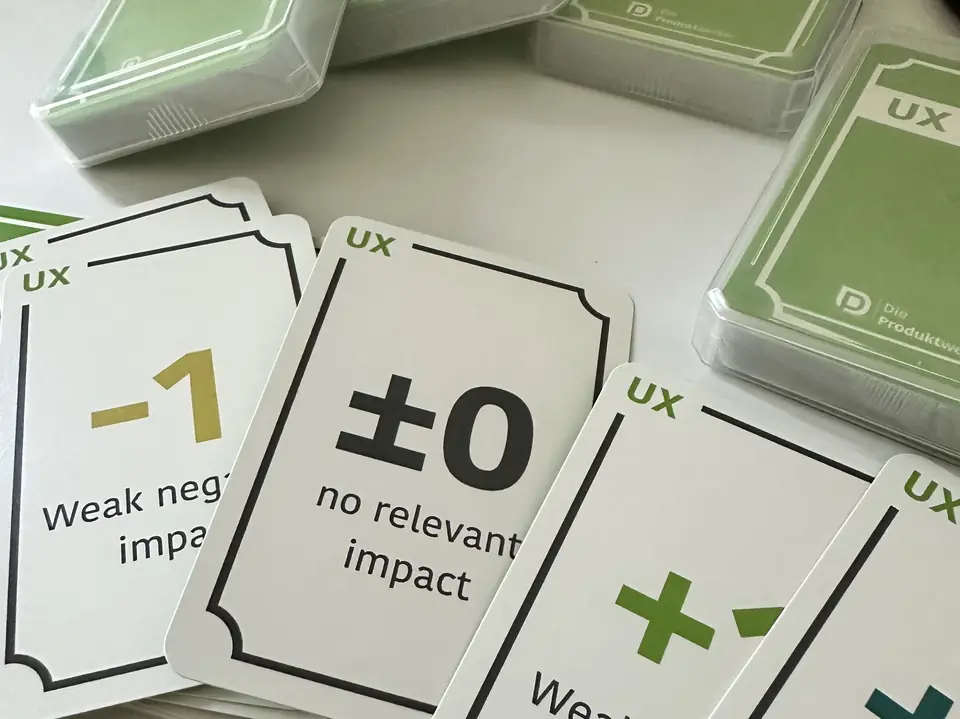
The cards
- +2 Strong positive impact
- +1 Weak positive impact
- ±0 No relevant impact
- −1 Weak negative impact
- −2 Strong negative impact
Everyone gets a set of five cards. The values describe the expected impact on one UX factor.
What is UX Poker?
Like Planning Poker – but for the user experience.
UX Poker is inspired by Planning Poker, where an agile team estimates how complex it is to implement a user story. In UX Poker, the team instead estimates how strongly a user story or epic influences the user experience – separately for each UX factor that matters for your product.
This way, every backlog item is assessed not only by effort but also by its expected UX. And the team takes the users’ perspective instead of talking only about technical implementation.
| Planning Poker | UX Poker | |
|---|---|---|
| Guiding question | How much effort is the implementation? | How does it affect the UX? |
| What is estimated | The complexity of a user story | The impact on each selected UX factor |
| Scale | Story points | −2 to +2 |
| Perspective | Technical implementation | The users’ experience |
| Result | Effort estimate in the backlog | Expected UX impact in the backlog |
Process
How to play UX Poker
UX Poker takes place in a team meeting. The product owner or product manager prepares the user stories or epics, and the whole team estimates.
What you need
- The UX factors of your UX vision – no more than five to seven, otherwise estimating becomes inefficient
- A shared understanding of the factors and the scale
- Personas, so it is clear whose perspective you estimate from
- Prepared user stories or epics
- One set of cards per person, or a voting tool for remote meetings
The five steps
Present
The product owner or product manager presents the user story or epic. The team clarifies the goal behind it.
Estimate secretly
For each selected UX factor, everyone secretly picks a card from −2 to +2.
Reveal together
Everyone reveals their cards at the same time, so nobody influences the others.
Discuss differences
If estimates differ by more than two scale steps, the people involved explain their view. Then the team estimates again.
Record the result
If there are no or only slight differences, record the average on the user story or epic.
In the end, every user story has an expected impact for each UX factor.
Example
One user story, four UX factors
This example comes from the UX Poker publication. For a short-message app, four UX factors were selected as important.
As a user, I want to see whether a post contains an untrue statement so that I can question it critically.
Working with the UX vision
From the canvas to the backlog
In step five of the UX Vision Canvas, you assess planned features by their impact on your UX factors. UX Poker is made for exactly this: the three to five factors of your UX vision are the factors you estimate.
With both effort and expected UX impact in the backlog, you can choose deliberately. If you want to improve attractiveness, for example, you prioritise user stories with a strong expected impact on that factor – and see early which stories might harm a factor.
You check whether the expected impact materialises with the measurements from step four. If measurements and estimates differ, adapt your plan.
Canvas instructions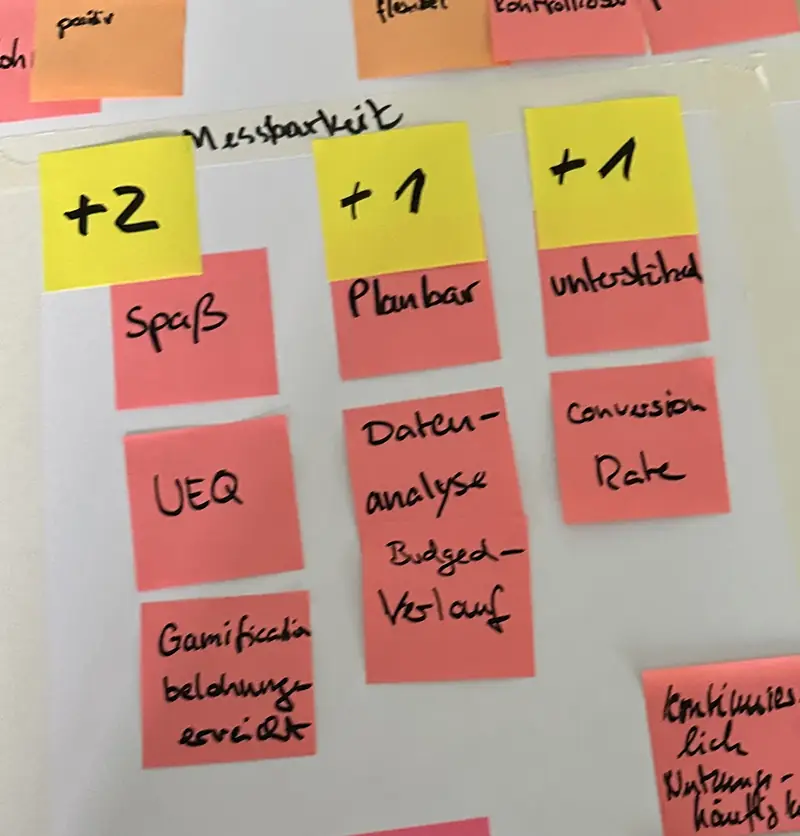
| Backlog item | Effort | Attractiveness | Transparency |
|---|---|---|---|
| Story A | 5 | +2 | −1 |
| Story B | 8 | +1 | −1 |
| Story C | 2 | +2 | ±0 |
| Task D | 13 | +1 | +1 |
| Story E | 20 | ±0 | −2 |
Tips from practice
What teams should keep in mind
These tips come from the teams that tried UX Poker in the study.
Clarify the UX vision
Your product’s UX vision should be clear before you estimate. Explain the UX factors so that everyone understands them the same way.
Agree on the scale
Discuss beforehand what a weak or strong impact means. Otherwise everyone estimates on a different yardstick.
Facilitate the discussion
Estimating almost always sparks a discussion. Without facilitation, it quickly loses focus.
Estimate from personas’ perspective
Decide which users you are estimating for. Personas help you put yourself in their shoes.
Think about the implementation
The same user story can have a positive or negative impact depending on how it is built. For a live ticker in a football app, the refresh rate decided whether the feature improved or worsened the UX. UX Poker brings such questions up early.
Use a voting tool remotely
In online meetings, a polling or voting tool speeds up secret estimation.
Support
Want to use the canvas with your team?
I support you in running it. Send me a short note about what you are working on and who will take part.
Workshop facilitation
I facilitate your workshop with the UX Vision Canvas – from what you know about users to measurable UX goals.
One-day training
Your team learns what UX visions are, applies several techniques for developing them to examples and discovers what else a UX vision can be used for.
or write directly to dominique.winter@designik.de