Tool · Canvas
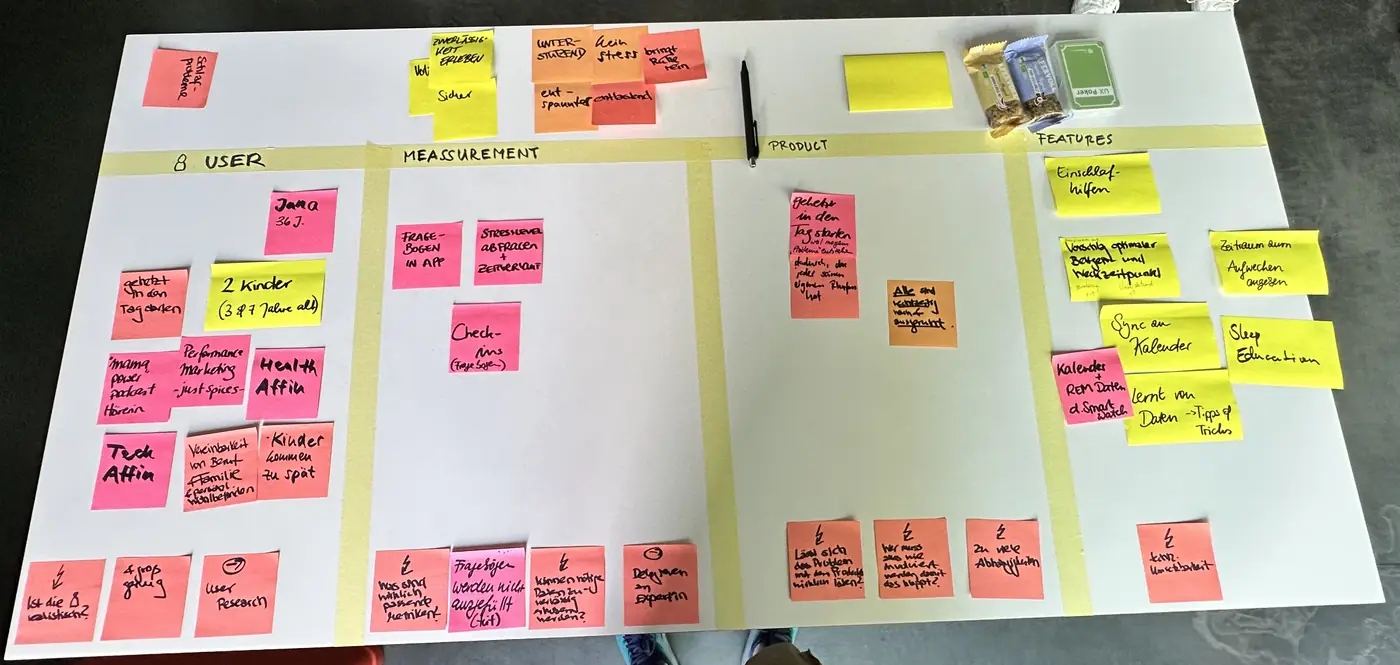
The UX Vision Canvas
Use these five steps to develop a shared UX vision as a team and connect it with measurable goals and planned features.
- Free to use
- 60–120 min for the UX vision
- CC BY-ND 4.0
- Developed by Dominique Winter
The canvas at a glance
What is our UX vision?
- What do we want users to talk about when they interact with our product?
- What adjectives and descriptions do they use?
- Which UX factors do we want to focus on?

Users
- What do we know about the users?
- What problems do the users have?

Measurement
- How can we measure the UX?
- How do we know how well we already fulfil a UX factor?
- What are our UX goals?

Product
- What do we know about our product?
- Which values does the product deliver – and which explicitly not?

Features
- What is the impact of the planned features on the UX factors?
- Which feature should benefit which aspect of the UX?

Challenges
What challenges do we have to overcome to get better in each of the four areas?
Process
Instructions
Step 1Users
Clarify what information or assumptions you already have about the people who will use your product. For example, share results from market research and user research and other artefacts that are already in use, such as personas or storyboards.
Step 2Product
Be clear about what your product is, what value it should deliver and, if necessary, what your product explicitly is not. This can include, but is not limited to, artefacts such as a feature list or a product backlog.

Step 3UX vision
Now it’s time to develop the actual UX vision. Take your time to do this. Everyone from the product team collects descriptions on cards that people ideally use to describe the user experience. One idea goes on each card, and everyone collects ideas on their own. This takes about two to five minutes. Then all the cards are put on the table and duplicates are removed. Everyone then groups the cards into clusters and names the clusters directly.
The clusters are now the factors of the UX that can be targeted. To maintain focus, the group decides which three to five factors belong to the UX vision.
Step 4Measurement
After the important UX factors have been determined, work out how the factors can be measured. These may be metrics that are already collected, or they may still need to be recorded and calculated. It is crucial, however, that measurability is accompanied by quantifiability. UX goals can then be derived from this.
Step 5Features
Once the UX goals are clear, evaluate the product’s planned features for their impact on the UX factors. Methods such as UX Poker can be used to estimate the strength of the effect as a team.
Next steps
How do I start?
Develop a UX vision and integrate it into your product vision. What is a UX vision?
Derive goals for the UX from it.
Evaluate possible changes to the product by their impact on the UX. With UX Poker
Regularly review the UX of your product.
Adapt your plan.
The canvas is a living document: keep maintaining it whenever you learn something new about users, product or measurements.
The scientific basis for the UX Vision Canvas
The development of a UX vision and the need for it due to many possible UX factors is not only the subject of the work of many practitioners but also part of scientific research. The following are important publications on the development of UX visions.
2023
Development of a Shared UX Vision Based on UX Factors Ascertained Through Attribution
International Journal of Interactive Multimedia and Artificial Intelligence, Vol. 8, Regular Issue No. 2, pp. 247–254.
doi:10.9781/ijimai.2023.04.001
2023
On the Importance of UX Quality Aspects for Different Product Categories
International Journal of Interactive Multimedia and Artificial Intelligence, Vol. 8, Regular Issue No. 2, pp. 232–246.
doi:10.9781/ijimai.2023.03.001
2022
UX Poker: Estimating the Influence of User Stories on User Experience in Early Stage of Agile Development
International Journal of Interactive Multimedia and Artificial Intelligence, Vol. 7, Regular Issue No. 7, pp. 97–104.
doi:10.9781/ijimai.2022.11.007
2015
Faktoren der User Experience – Systematische Übersicht über produktrelevante UX-Qualitätsaspekte
In: Endmann, A.; Fischer, H.; Krökel, M. (eds.): Mensch und Computer 2015 – Usability Professionals. De Gruyter, pp. 33–41. In German.
doi:10.1515/9783110443882-005
Support
Want to use the canvas with your team?
I support you in running it. Send me a short note about what you are working on and who will take part.
Workshop facilitation
I facilitate your workshop with the UX Vision Canvas – from what you know about users to measurable UX goals.
One-day training
Your team learns what UX visions are, applies several techniques for developing them to examples and discovers what else a UX vision can be used for.
or write directly to dominique.winter@designik.de