Tool · Product Vision Interview
Product Vision Interview
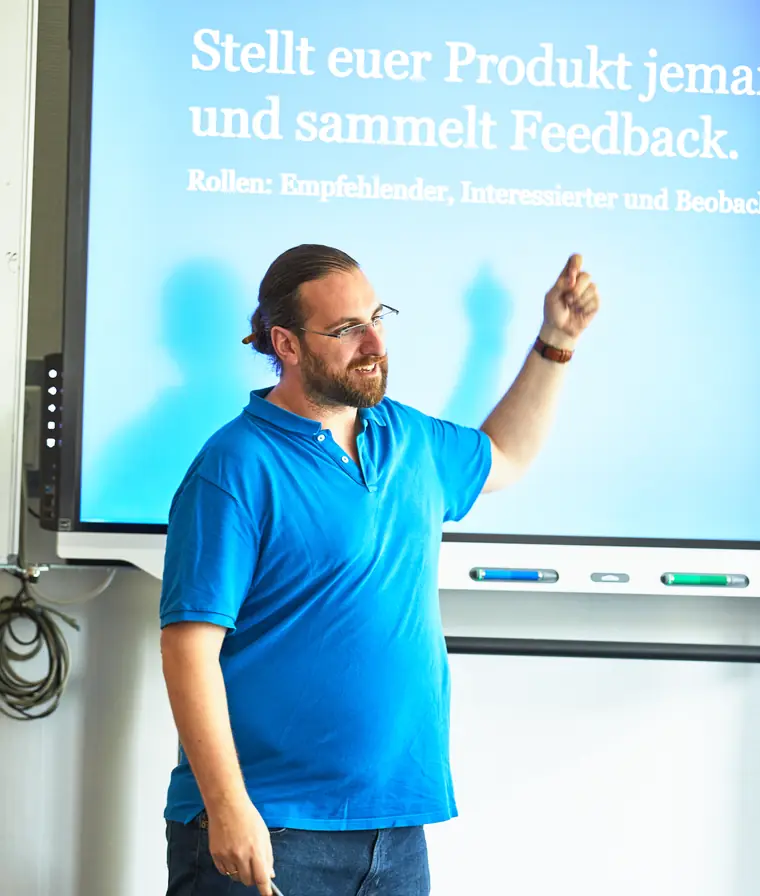
A short role play in which your team gets to the point of why your product is valuable – in the language of your target group.
- Free
- Three roles
- Rounds of about five minutes
- By Dominique Winter
What is it about?
A product vision emerges in conversation.
Shared understanding is created first and foremost through dialogue. In the Product Vision Interview, the team therefore uses a role play to develop a shared narrative of the product – in the language of the target group.
The exercise is based on the role play “good product, bad product”. It prepares more structured formats such as Roman Pichler’s Product Vision Board or Geoffrey Moore’s positioning statement.
“The goal of a good product vision should be to get to the point of why your own product is valuable – quickly and simply.”
Roles
Three roles that rotate
Promoter
Presents the product to an interested person and recommends it.
Interested person
Asks questions, digs deeper and voices criticism.
Observer
Listens quietly and notes what stands out.
Process
How the Product Vision Interview works
Set the stage and the rules
Agree on the situation in which the product is presented and how the rounds work.
Role play in rounds
In groups of three, play the conversation for about five minutes. Then swap roles until everyone has had every role once.
Summarise the results
Bring together what was convincing in the rounds and turn it into a short, emotional product description – short enough to fit on an index card.
Test it with an audience
Present the description to a group. The listeners write down what stuck with them.
Sharpen it
If the important points don’t stick, play further rounds and sharpen the description.
Result
From conversation to positioning statement
The short product description is a good basis for a structured positioning statement. To write it, agree on your target group’s core problem and the most important benefit of your product. The template is an adapted version of Geoffrey Moore’s positioning statement.
For target group that has the following problem, our product name is a product type that has these key features to create the following customer benefit.
Tips
Making the conversation work
In person, in the right room
The conversation thrives on direct dialogue. Ideally, run the exercise in person in a room where the groups can talk undisturbed.
Your target group’s language
Talk about the product the way people from your target group would – not in project language.
Warm up
A short warm-up exercise lowers the barrier before the role play.
Gentle start
Anyone who feels reserved can start in the observer role.
Working with the UX vision
The basis for the product area
In step two of the UX Vision Canvas, you clarify what value your product should deliver – and what it explicitly should not. The Product Vision Interview provides a shared, tellable answer before you develop the actual UX vision.
Canvas instructionsSupport
Want to use the canvas with your team?
I support you in running it. Send me a short note about what you are working on and who will take part.
Workshop facilitation
I facilitate your workshop with the UX Vision Canvas – from what you know about users to measurable UX goals.
One-day training
Your team learns what UX visions are, applies several techniques for developing them to examples and discovers what else a UX vision can be used for.
or write directly to dominique.winter@designik.de